
Parliamentary Ombudsman addresses international seminar in Bilbao on strengthening Ombuds institutions
Published November 18, 2026
Parliamentary Ombudsman addresses international seminar in Bilbao on strengthening Ombuds institutions
Published November 18, 2026
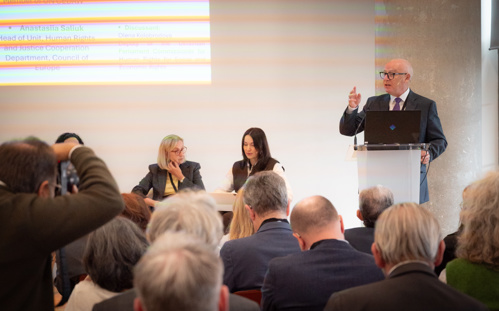
The Parliamentary Ombudsman, Judge Joseph Zammit McKeon, is participating in an international seminar in Bilbao and Gernika organised by the Ararteko-Ombudsman of the Basque Country in collaboration with the International Ombudsman Institute (IOI).
The two-day seminar, entitled “Strengthening Ombuds Institutions to Underpin Democracy”, brings together Ombudsman institutions, academics and representatives of European and international organisations to discuss how independent oversight institutions can respond to the evolving challenges facing democracy, the rule of law and human rights in Europe.

Opening the seminar, Mikel Mancisidor, Ararteko-Ombudsman of the Basque Country, said the conference provided an opportunity for Ombudsman institutions to consider what they can learn from each other and how they can collectively face emerging challenges from an Ombudsman perspective.
The first day began with a keynote address by Professor Naomi Creutzfeldt of the University of Kent on Ombuds institutions and the challenges facing democracy in Europe.
Professor Creutzfeldt focused on the relationship between Ombudsman institutions, human rights and the rule of law. She highlighted their role in protecting rights, promoting the rule of law and ensuring that public authorities exercise their powers lawfully and fairly. Their independence, she noted, enables them to scrutinise government action, identify systemic weaknesses and recommend reforms that strengthen the protection of fundamental rights.

Addressing democratic backsliding in Europe, Professor Creutzfeldt referred to the weakening of democratic institutions, restrictions on civil liberties, declining judicial independence and increasing political interference in public administration. Against this background, Ombudsman institutions can serve as important safeguards by monitoring public administration, investigating abuses of authority and drawing attention to violations of fundamental rights.
She also placed particular emphasis on people-centred justice, which puts the needs, experiences and rights of persons at the centre of public administration and justice systems. Such an approach requires accessibility, fairness, transparency, responsiveness and meaningful participation by citizens in decisions affecting their lives. Ombudsman institutions, she argued, can contribute to making public services more inclusive, effective and responsive.
Professor Creutzfeldt further referred to the importance of international standards in strengthening the independence, effectiveness and credibility of Ombudsman and human rights institutions, including the Venice Principles and the Paris Principles. She highlighted the growing international recognition of independent Ombudsman institutions as safeguards of the rule of law, accountability and protection against maladministration.
Collaborative frameworks for a changing environment
Judge Joseph Zammit McKeon participated in the first panel discussion, “Collaborative Frameworks for Adapting the Role of Ombuds Institutions”, alongside Marta Hirsch-Ziembinska, Principal Advisor at the European Ombudsman, Ana Pélaez, Member of the United Nations Committee on the Elimination of Discrimination against Women, and Anastasiia Sailuk from the Council of Europe.

In his intervention, the Parliamentary Ombudsman focused on how Ombudsman institutions can strengthen democracy by developing stronger frameworks and collaborative networks while preserving the independence and values at the core of their mandate.
He noted that Ombudsman institutions today operate in an environment marked by political and social uncertainty, rapid technological development, increasingly complex public administrations, environmental challenges, migration pressures and declining trust in public institutions.
Against this background, he argued that Ombudsman institutions must adapt without compromising their fundamental commitment to accountability, fairness, transparency and respect for human dignity.
Judge Zammit McKeon identified institutional resilience and operational innovation as two essential elements of this process.
He stressed that independence remains the cornerstone of every Ombudsman institution, while innovation is increasingly necessary as citizens expect services that are accessible, responsive and user-friendly. This requires investment in staff, digital accessibility, efficient complaint handling and stronger engagement with communities and stakeholders.
Ombudsman institutions cannot operate in isolation
A central theme of the Ombudsman’s intervention was the importance of international cooperation.
“No matter how domestically efficient it can be, an Ombudsman institution, regardless of its resources or experience, cannot operate effectively in isolation,” he said.
He argued that collaborative networks allow Ombudsman institutions to exchange good practices, identify emerging trends and develop common approaches to challenges which increasingly extend beyond national borders.
Artificial intelligence, digital platforms, climate change, migration and cybersecurity all present issues that cannot be addressed effectively within the confines of a single jurisdiction.
“Collaboration does not damage independence. On the contrary, collaborative networks foster solidarity among institutions that share a common commitment to good governance and the rule of law.”
Judge Zammit McKeon also highlighted the importance of cooperation with civil society and academic institutions. Civil society organisations can provide insight into the experiences of vulnerable groups and help identify systemic problems, while universities and research institutions can assist Ombudsman offices in understanding emerging trends and evaluating policy developments.
As an example, he referred to the Master of Arts in Ombudsman Law and Governance established jointly by the University of Malta and the Office of the Parliamentary Ombudsman. The programme, launched in October 2025, brings together Ombudsman law, administrative justice, human rights, public administration and good governance.
Preparing for artificial intelligence and emerging challenges
The Parliamentary Ombudsman also addressed the impact of digitalisation and artificial intelligence on public administration.
He noted that automated systems can be difficult for persons to understand or challenge, while digital exclusion can leave vulnerable persons behind. Ombudsman institutions therefore need the expertise and training necessary to assess new technologies and their impact on rights.
He referred in this context to the IOI Academy programme that will be hosted in Malta in 2027 and will focus on the safe and effective application of artificial intelligence in the work of Ombudsman institutions.
Judge Zammit McKeon called for more practical forms of international cooperation, including shared investigative methodologies for artificial intelligence and automated decision-making, common training programmes, joint research, early-warning mechanisms and thematic working groups dealing with emerging areas of public administration.
He concluded that the Ombudsman of the future does not need to become a different institution or abandon its established values. Instead, it must remain accessible, independent and committed to justice while adapting to new realities.
He also stressed the importance of responsible outreach, arguing that greater visibility can strengthen rather than compromise independence when it is used to educate the public about the role of the institution.
“Effective outreach enables the Ombudsman to become a familiar democratic institution rather than a distant constitutional office,” he said.
The first day continued with a session dedicated to Ombudsman outreach practices and ways of bringing institutions closer to citizens. Speakers shared experiences involving citizen advice offices, engagement with children, territorial accessibility and international good practices in Ombudsman outreach.
