
Speech by the Ombudsman during a conference on ‘Strengthening democracy through stronger ombuds institutions’ in Bilbao
Published November 18, 2026
Speech by the Ombudsman during a conference on ‘Strengthening democracy through stronger ombuds institutions’ in Bilbao
Published November 18, 2026
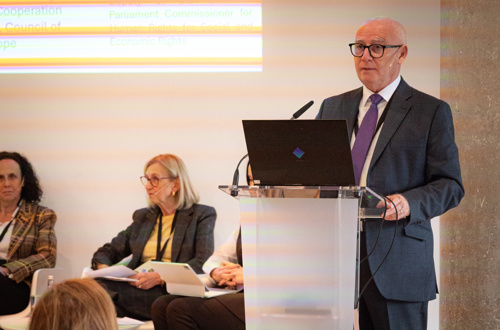
Speech by the Ombudsman during a conference on ‘Strengthening democracy through stronger ombuds institutions’ in Bilbao
Frameworks and collaborative networks
for adapting the role of ombuds
institutions to evolving demands
Bilbao, Spain
The Office of the Ombudsman has evolved from the concern that public authority must be accountable, fair, transparent and respectful of human dignity.
These values are still relevant today as they were in the past even though the context in which we operate today has changed dramatically.
We are living in times of:
- obstinately persistent uncertainty and unrest,
- developments in technology that have been so rapid that their vulnerabilities have been experienced by millions worldwide,
- growing expectations from the public seeking redress,
- increasingly complex public administrative structures,
- serious environmental challenges,
- migration pressures and
- across all continents, a swift decline of trust in public institutions.
Against this backdrop, Ombudsman institutions have to adjust without putting aside the principles that are core to their mandate.
This includes developing and strengthening frameworks, partnerships and collaborative networks that help the institutions to carry out their mandate better and more effectively.
No domestic Ombuds institution should believe that it can operate effectively alone or in isolation. The real world has proved the contrary, with all due respect to all who believe otherwise.
The process of adjustment requires structure, primarily:
i. institutional resilience; and
ii. operational innovation.
Institutional resilience sustains independence which remains the cornerstone of every Ombudsman institution. Without independence, public confidence erodes. Without public confidence, effectiveness becomes weak. To be resilient, Ombudsmen have to practise also the value of patience and understanding at 360 degrees.
Operational innovation is a must because people increasingly expect services to be accessible, responsive and user-friendly.
Ombudsman institutions must therefore invest in human resources that are understanding and willing to widen their knowledge and perspectives, in digital accessibility, in efficient complaint handling and proactive engagement with the community and its stakeholders.
I insist.
No matter how domestically efficient it can be, an Ombudsman institution, regardless of its resources or experience, cannot operate effectively in isolation.
Collaborative networks provide an essential method for institutional learning and collective action.
International cooperation among Ombudsman institutions allows for the exchange of best practices, awareness of emerging trends, and the development of common approaches to shared challenges.
The most significant challenges that face Ombuds institutions no longer originate exclusively within national borders:
- Artificial intelligence is developed for global purposes.
- Digital platforms operate everywhere.
- Climate change makes borders insignificant.
- Migration moves beyond States.
- Cybersecurity is a major, if not the most vital, concern of primary importance, as its vulnerabilities affect the rights and dignity of the person.
Collaboration does not damage independence. On the contrary, collaborative networks foster solidarity among institutions that share a common commitment to good governance and the rule of law.
These are not hollow slogans but the fruit of positive experience.
Co-operation allows smaller jurisdictions to contribute their perspectives to broader international discussions. Their experiences are relevant because their proximity to people allows for greater responsiveness.
Engagement can also extend to civil society, especially those organisations that operate on the frontline of social challenges. They hold valuable insights into the experiences of vulnerable groups. For Ombudsman institutions, they constitute an important source of understanding and enable them to identify systemic issues that may not yet have been reflected in individual complaints.
Institutions of learning and research help Ombudsman offices understand emerging trends, evaluate policy impacts and propose innovative responses. The reverse applies as well because these institutions can absorb knowledge from the experience of Ombudsman Offices.
Example:
Master of Arts (MA) Degree in Ombudsman Law and Governance is a pioneering postgraduate programme established through collaboration between the University of Malta and the Office of the Parliamentary Ombudsman of Malta which started in October 2025.
It is the first postgraduate degree of its kind in Europe, bringing together Ombudsman law, administrative justice, human rights, public administration and good governance, successfully managed jointly by the Faculty of Laws and the Faculty of Economics, Management and Accountancy of the UOM.
The programme of study has three interconnected objectives:
Academic to develop a specialised body of knowledge concerning Ombudsman law, constitutional principles and comparative governance.
Professional to equip participants with practical investigative, mediation, complaint-handling and administrative skills.
Institutional to strengthen a culture of good governance, transparency, accountability and respect for citizens' rights throughout the public administration.
Automated systems affect persons that may find them difficult to understand or challenge. Digital exclusion may leave vulnerable persons behind or at the side. Ombudsman institutions must therefore develop the expertise necessary to evaluate new technologies and their impact on the rights of people. For this to happen, requires investment, special training and international cooperation. Collaborative networks become particularly important in areas where specialist expertise is moving rapidly ahead. Digital transformation has altered the relationship between service receivers and the public administration. The environment within which Ombuds Offices operate has become all the more complex. By sharing experiences and human resources, Ombudsman institutions can strengthen their ability to experience and oversee technological governance.
Example:
2027 IOI Academy Programme to be held in Malta on the safe and efficient application of AI in the work of the Ombudsman.
In the public administration of today, responsibilities are widely scattered. Once the exercise of public authority has widened, democratic accountability is crucial. Oversight institutions, that in the past, functioned largely within clearly defined institutional boundaries must look ahead and face new fast-moving realities.
Examples:
- An investigation into the use of artificial intelligence in public administration may involve questions of administrative fairness, data protection, privacy, equality, transparency and human rights taken together.
- Environmental governance combines planning law, public health, environmental protection, climate action and local government, apart from the enforcement of international legal obligations.
- Migration engages national administrations, border authorities, human rights standards, international organisations and judicial review.
In these and other issues, we cannot and should not be placed in corners, but rather we should push forward collaboration across borders.
We should work towards practical forms of cooperation - networks through which Ombuds institutions share investigative methodologies for artificial intelligence and automated decision-making.
- common training programmes enabling investigators to develop expertise in emerging technologies.
- research projects examining systemic challenges affecting public administration across jurisdictions.
- early-warning mechanisms identifying new risks before they become widespread patterns of maladministration.
- thematic working groups capable of producing shared principles on good administration in areas where public authorities increasingly confront common challenges.
Domestic Ombuds institutions must support international frameworks, without having to surrender their mandate.
To remain fresh and relevant, the Ombudsman of the years to come does not need to be a different institution. Nor should it ever be required to surrender its values. Commitment to justice has to remain unwavering.
Collaborative networks assist Ombudsman institutions to address better the relationship between administrative justice and human rights protection, even though mandates can differ across jurisdictions.
The Ombudsman should remain one of the most approachable institutions. Its legitimacy depends not only upon constitutional recognition but upon the trust of the public.
To conclude
On the basis of my experience in the regional network of Ombudsmen and beyond, I can safely state that:
- whether entrusted with a broad mandate or within a more focused jurisdiction confined to maladministration, the Ombuds institution shares the same ultimate objective, being to strengthen public confidence in democratic governance.
- perhaps the greatest opportunity for strengthening Ombuds institutions lies in strategic outreach. Some Ombuds institutions have adopted a reserved public profile, fearing that visibility might compromise impartiality. Experience suggests otherwise. Visibility, when exercised responsibly, can enhance independence.
- effective outreach enables the Ombudsman to become a familiar democratic institution rather than a distant constitutional office. Importantly, outreach should educate rather than advocate. The institution itself should prove to the public that it is not just an observer of administrative change but an active contributor to ensuring that public services can be innovative while respecting justice and fairness.
