
Parliamentary Ombudsman addresses international conference in Nicosia on the evolving role of Ombudsman institutions
Published November 11, 2026
Parliamentary Ombudsman addresses international conference in Nicosia on the evolving role of Ombudsman institutions
Published November 11, 2026
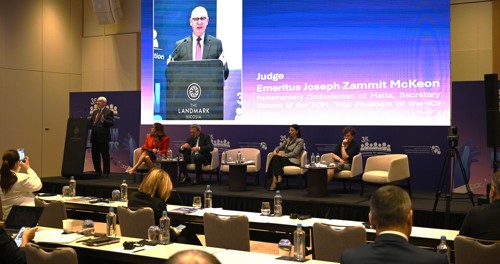
The Parliamentary Ombudsman, Judge Joseph Zammit McKeon, is participating in a regional conference in Nicosia marking the 35th anniversary of the establishment of the Office of the Commissioner for Administration and the Protection of Human Rights of Cyprus.
The two-day conference, jointly organised by the Cyprus Ombudsman and the Association of Mediterranean Ombudsmen (AOM), is being held under the theme “The reflection of the institution on improving citizens’ quality of life and protecting human rights throughout its 35-year journey”. It brings together Ombudsman institutions and human rights bodies to discuss their evolving role, expanding mandates and the challenges facing independent oversight institutions.
The first day of the conference focused on “The Ombudsman Institution in a Changing Democratic and Human Rights Landscape”.
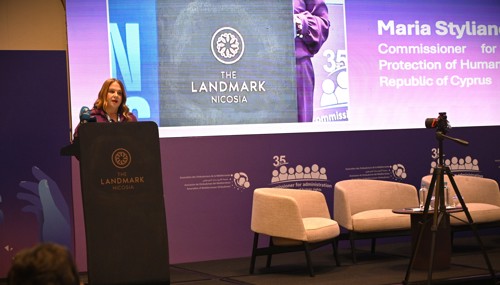
Opening the conference, Maria Stylianou-Lottides, Commissioner for Administration and the Protection of Human Rights of Cyprus, highlighted the opportunities and challenges facing Ombudsman institutions while stressing the importance of safeguarding their mandates and independence. She also underlined the value of active participation by citizens and their representatives.
Demetris Demetriou, President of the Parliamentary Committee on Institutions, Merit and the Commissioner for Administration, referred to the respect afforded to the work of the Cypriot Ombudsman institution. He noted that its recommendations are, in most cases, implemented by the public administration and highlighted the positive cooperation between Parliament and the institution.
Reinier Van Zutphen, President of IOI Europe and National Ombudsman of the Netherlands, stressed that human rights considerations increasingly form part of the everyday work of Ombudsman institutions, including in areas such as housing and healthcare. He said that, at a time of growing instability, Ombudsman institutions are needed more than ever as stable and independent institutions capable of defending rights that can no longer be taken for granted.
Gianluca Esposito, Director General for Human Rights and Rule of Law at the Council of Europe, emphasised that independent institutions are vital to democratic systems. He referred to the Council of Europe’s recognition of Ombudsman institutions as important human rights partners and highlighted the value of exchanging experience and learning from one another.
In a recorded video message, Nadine Mailloux, President of the International Ombudsman Institute, referred to the increasingly complex challenges facing societies and the need for Ombudsman institutions to respond to evolving expectations from citizens. She stressed that public services cannot be considered effective if they are not accessible to those who need them most.
The opening session also included an address by Nicos Charalambous, the first Commissioner for Administration of the Republic of Cyprus and former Deputy Attorney General.
From complaints to systemic impact
Judge Joseph Zammit McKeon, who is Secretary General of the AOM and Vice President of IOI Europe, addressed the first panel discussion, “From Complaints to Impact: The Evolving Role of Ombudsman Institutions”.
In his intervention, entitled “The Evolution of the Ombudsman Mandate: From Complaint Handling to Systemic Impact”, the Parliamentary Ombudsman reflected on how the institution must continue to evolve in response to changes in public administration and citizens’ expectations.
He stressed that investigating complaints remains the primary function of the Ombudsman. A person who believes that a public authority has acted unfairly must continue to have access to an independent and impartial institution capable of investigating the matter and seeking adequate redress.
“No customer care office of Government can substitute the independent function of the Ombudsman,” he said, stressing that every complaint represents a person seeking fair treatment.
The Ombudsman argued, however, that complaints should also be viewed as an important source of information about the performance of public administration. Individual cases can reveal unclear legislation, inadequate procedures, systemic delays, inconsistent decision-making, weaknesses in communication and institutional cultures resistant to accountability.
He described complaint handling as capable of becoming an “early-warning system for democratic governance”, allowing Ombudsman institutions to identify recurring failures and their underlying causes before they develop into wider problems.
Judge Zammit McKeon also highlighted the growing importance of own-initiative investigations, which allow Ombudsman institutions to examine systemic problems without waiting for an individual complaint. Such investigations can assess whether legislation creates unfairness, policies are applied consistently, digital systems disadvantage vulnerable persons or administrative delays point to deeper structural problems.
New challenges for independent oversight
The Parliamentary Ombudsman also addressed the challenges arising from the increasing use of artificial intelligence, algorithms and digital platforms within public administration.
While acknowledging the opportunities offered by technological innovation, he warned of risks including digital exclusion, automated bias, excessive surveillance and weak accountability.
“Technology cannot be allowed to reduce or put aside altogether the dignity of the person. Nor should efficiency replace fairness.”
He argued that Ombudsman institutions must ensure that innovation remains consistent with the principles of good administration and that technological development does not leave persons behind or exclude them from public services.
Judge Zammit McKeon also cautioned against assessing the success of Ombudsman institutions solely through statistics such as the number of complaints received or investigations concluded. The real measure of effectiveness, he said, should include lasting improvements in public administration and the prevention of recurring maladministration.
He concluded that independent oversight requires courage, particularly when recommendations challenge established practices, and reaffirmed the Ombudsman’s role in promoting transparent, participatory and evidence-based administration respectful of the rule of law.
“By striving for good administration through independent oversight, Ombudsman institutions can strengthen the observance of the rule of law not as an abstract ideal but as the very essence in the lives of people.”
The first day continued with discussions on the expanding mandates of Ombudsman institutions, including the challenges of combining responsibilities in good administration, human rights, equality and independent monitoring. A further session examined institutional effectiveness, the implementation of Ombudsman recommendations, accountability, the rule of law and the importance of public confidence in independent oversight.
