
Commissioner for Education delivers concluding remarks at University of Malta Research Symposium
Published May 21, 2026
Commissioner for Education delivers concluding remarks at University of Malta Research Symposium
Published May 21, 2026
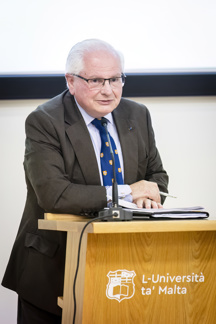
The Commissioner for Education, Chief Justice Emeritus Vincent De Gaetano, delivered the concluding remarks at the Policy, Politics and Governance Research Symposium organised by the Department of Policy, Politics and Governance within the Faculty of Economics, Management and Accountancy at the University of Malta. The symposium was held on Friday 8 May 2026 at the University of Malta.
The event brought together students, graduates, academics and practitioners to discuss dissertation research on issues relevant to public policy, governance and contemporary Maltese society. The programme was structured around four main themes: complexity and competitiveness in policy making, administrative governance, governing land resources, and security governance.
In her welcome address, Dr Marie-Louise Mangion, Head and Deputy Dean of the Department of Policy, Politics and Governance, described the symposium as an opportunity to share research conducted by students and reviewed by internal and external examiners. She noted that the discussions would address key challenges facing society, including policy implementation, political narratives, institutional resilience, and the need for stronger professionalisation in public institutions.
The student presentations and discussions covered a wide range of subjects. These included IVF policy in Malta, populism and policy making, poverty reduction and social inclusion, the competitiveness of Malta’s fruit and vegetable farming community, the use of artificial intelligence in public administration, Parliamentary Questions and Freedom of Information requests, planning decisions, hazardous waste controls, overdevelopment and quality of life among Gen-Zs, emerging technologies in the Malta Police Force reporting system, Malta’s OSCE Chairpersonship, and leadership pathways for female officers in the Malta Police Force.
Several of the dissertations addressed themes closely connected to good governance and public administration. Research on artificial intelligence in public administration examined how policymakers perceive AI, noting both its potential to improve efficiency and the need to address transparency, accountability and the continued role of human judgement. Another study explored Parliamentary Questions and Freedom of Information requests as mechanisms of transparency and accountability.
Other research focused on land use and environmental governance. Presentations addressed stakeholder engagement in planning decisions, hazardous waste controls in Customs operations, and the impact of overdevelopment on the quality of life of younger generations in Malta. These discussions highlighted the importance of evidence-based policy, meaningful participation, and long-term planning.
The security governance session addressed the use of emerging technologies within the Malta Police Force reporting system, Malta’s role within the Organisation for Security and Co-operation in Europe, and leadership within the Police Force. These themes reflected the wider relevance of governance research to institutional effectiveness, security, transparency and public trust.
At the end of the proceedings, the Commissioner for Education congratulated all those who presented and discussed their research findings during this year’s Dissertation Research Symposium. He noted that the sample of dissertations discussed reflected the commitment of the Department of Policy, Politics and Governance to addressing issues vital to contemporary Maltese society on an empirically grounded and theoretically informed basis.
Chief Justice Emeritus De Gaetano observed that a common theme running through the group discussions was the quality of life. This theme emerged across several areas, including IVF regulation, artificial intelligence, Parliamentary Questions, social exclusion, planning permit decision making, hazardous waste control, the Malta Police Force’s reporting system, and the competitiveness of Malta’s fruit and farming community. He noted that, in the middle of an election campaign, quality of life was being widely referred to in public debate, with many promises being made, but often without the backing of hard evidence on feasibility and sustainability.
The Commissioner also congratulated the discussants on the excellent level of their verbal communication skills.
The Office of the Ombudsman continues to support academic engagement on public administration, good governance and accountability. Together with the Faculty of Laws and the Department of Policy, Politics and Governance, the Office is also collaborating on the Master of Arts in Ombudsman Law and Governance, a programme that is currently underway and reflects the shared commitment to strengthening knowledge and research in this field.
