
Parliamentary Ombudsman highlights environmental oversight and climate responsibility at European Network of Ombudsmen meeting
Published January 13, 2026
Parliamentary Ombudsman highlights environmental oversight and climate responsibility at European Network of Ombudsmen meeting
Published January 13, 2026
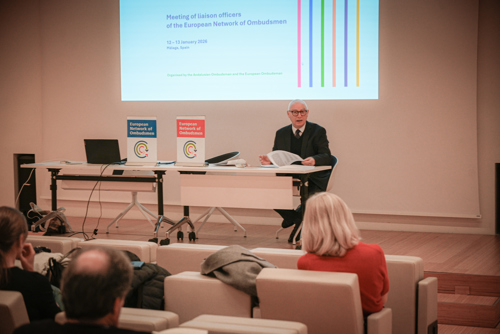
The second day of the European Network of Ombudsmen meeting in Malaga opened with a keynote address by Prof Dr Joana Mendes of the University of Luxembourg on the theme of EU law as local knowledge. Her address focused on how EU law shapes daily realities and the importance of initiatives that translate complex legal frameworks into practical tools that citizens and public administrations can understand and apply.
The conference then moved to the presentation of conclusions from the eight workshops held during the ENO Conference in Brussels in November 2025. The Parliamentary Ombudsman of Malta, Judge Joseph Zammit McKeon, delivered the conclusions of the workshop Sharing ombudsmen experience in dealing with environmental complaints, drawing on the shared experience of ombudsman institutions across Europe.
In his intervention, the Parliamentary Ombudsman underlined that environmental protection should be treated as a top priority, based on the principle that the environment is the common heritage of humankind. He stressed that climate change is neither a theoretical concept nor a distant threat, but a present and serious reality that must inform the work of oversight bodies.
The workshop noted the significance of the Advisory Opinion delivered by the International Court of Justice on 23 July 2025 on the obligations of states in respect of climate change. While not legally binding, the opinion carries strong moral authority and provides important guidance for public policy and oversight. It affirms that states have a duty to protect the environment from greenhouse gas emissions and recognises the right to a clean, healthy, and sustainable environment as a human right essential to the enjoyment of other rights.
Participants of the workshop highlighted that environmental protection and climate change mitigation have become transnational concerns. The negative effects of environmental harm and inaction do not stop at national borders and directly affect future generations. Oversight bodies therefore have a responsibility to address these issues through effective investigations and well-founded recommendations.
Common challenges identified across jurisdictions included limited access to environmental information, overly formalistic assessments disconnected from real conditions, outdated industrial facilities, misapplication of EU environmental law, lengthy procedures, lack of specialised resources, weak administrative responsiveness, insufficient ambition in climate policy, growing pressure on natural resources, and persistent greenwashing.
A lack of awareness of environmental legislation was also identified as a factor contributing to inconsistent enforcement.
The discussion emphasised that the EU already has a substantial body of environmental legislation in place, including the Aarhus Convention, the Bern Convention, and the Natura 2000 framework. The main challenge lies not in adopting new laws but in ensuring consistent and effective implementation and enforcement. Environmental matters account for a significant proportion of EU infringement proceedings, highlighting the need for stronger compliance mechanisms.
Attention was also given to the use of practical guidance tools, including EU vademeca, as non-binding instruments that support better administration, complaint handling, and citizen involvement. These tools were identified as particularly useful for ombudsman institutions as shared reference points for oversight action.
Examples from different countries illustrated how environmental complaints arise in varied contexts, including wildlife management, noise pollution, wildfires, and delays or failures in administrative procedures. These experiences reinforced the importance of strong recommendations and public accountability, including engagement with parliament, the media, and the public.
The Parliamentary Ombudsman highlighted the value of parallel investigations where legally possible, especially for systemic issues. Such cooperation allows ombudsman institutions to connect their findings, strengthen their conclusions, and, where appropriate, inform the European Commission of potential breaches of EU law.
The session also examined the growing recognition of environmental protection as a human rights issue. Recent case law of the European Court of Human Rights confirms that inadequate state action on environmental matters may amount to violations of fundamental rights. This development adds weight and responsibility to the work of ombudsman institutions and underlines the importance of own initiative investigations, even in the absence of individual complaints.
The day concluded with presentations on projects marking thirty years of the European Network of Ombudsmen. These included the ENO Code for the Functioning of Ombudsmen Offices in the Era of Accelerated Innovation, the ENO thirty-year anniversary report to the European Parliament, and discussions on how the Network can contribute to EU law making processes that affect ombudsman institutions and the rights of EU citizens.
