
Case Study - Claim for Damages Following Roadworks
Published October 06, 2026
Case Study - Claim for Damages Following Roadworks
Published October 06, 2026
The Complaint
The Commissioner for Environment and Planning investigated a complaint concerning a claim for damages to the tyres of a motor vehicle, allegedly caused by the condition of a road left in an unfinished and abrasive state during roadworks.
The Investigation
The complainant submitted that he was required to replace two high-grade front tyres prematurely, which he attributed to the unfinished and abrasive condition of the road. He maintained that the relevant section of the road, including the area beneath the pavement, had remained in an unsatisfactory condition for approximately three years, following repeated trenching and reinstatement works. According to the complainant, the failure to properly maintain and reinstate the road resulted in conditions that were unsafe and unsuitable for normal use.
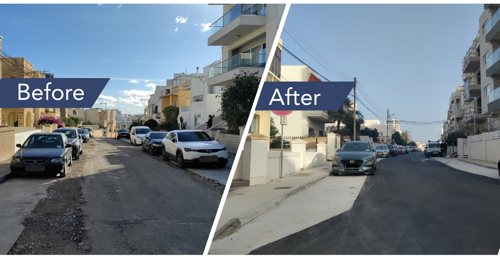
During an on-site inspection, the Commissioner observed an open trench, with the areas beneath the footpaths having been paved with concrete. The location was subject to a 30km/h speed limit. A subsequent inspection confirmed that the road surfacing and footpath works had been completed.
The complainant further submitted that the tyres concerned had an expected lifespan of between 70,000km and 100,000km, or approximately ten years. However, information published on the tyre manufacturer’s official website indicates that comparable tyres have an expected lifespan of approximately 50,000km, although this may be reduced by more than 50%, depending on driving conditions and behaviour.
The evidence submitted by the complainant showed that the damage was concentrated on the outer edges of the two front tyres. The nature and location of the damage were considered in assessing whether the condition of the road could reasonably be regarded as the cause of the premature deterioration. On the evidence available, the pattern of damage was not consistent with damage that would ordinarily be expected to result from driving over rough concrete or gravel at speeds below 30km/h, since such use would reasonably be expected to affect the portions of the tyre in primary contact with the road surface, including the inner tread ribs. Similarly, the damage identified was not considered characteristic of deterioration resulting from turning the front wheels on a rough surface while the vehicle was stationary or moving at very low speed, such as during parking manoeuvres. Rather, the location of the damage on the outer edges of the tyres was considered more compatible with stresses associated with driving perpendicularly over changes in level, such as when mounting a kerb.
Accordingly, while the Commissioner acknowledged that roadworks had been carried out at the location and that sections of the road had, at the time of the inspection, not yet been fully reinstated, the evidence available did not establish a sufficiently direct causal connection between the condition of the road and the damage sustained to the complainant’s tyres.
Conclusion
Having considered the representations made by the complainant, the findings of the site inspections, the available evidence concerning the expected lifespan of the tyres, and the nature and location of the damage, the Commissioner found that the allegation that the tyre damage was caused by the condition of the road during the roadworks had not been substantiated.
Consequently, the claim for damages against Infrastructure Malta was not upheld.
